
The Bean Soup Theory
What TikTok comments reveal about human behavior, relevance, focus, and modern marketing

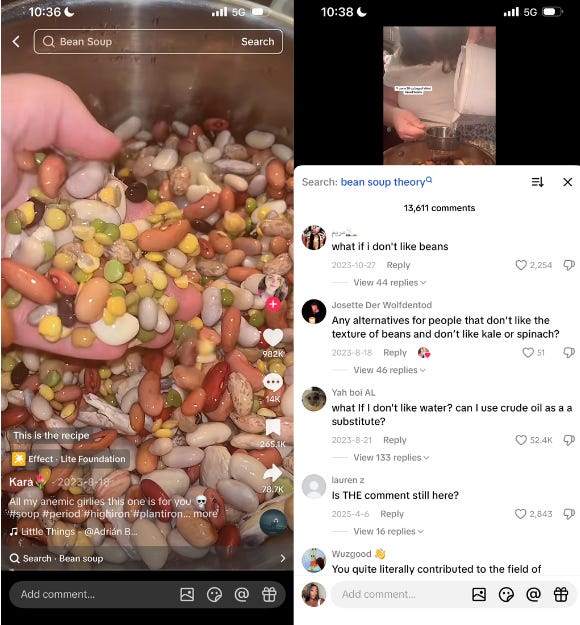
Someone posted a video about their bean soup recipe. No hot take. No lesson. Just a person making a soup they like, in the way they like to make it.
The comments did that thing TikTok comments always do.
People started explaining why it would not work for them.
They didn’t like beans.
They were allergic.
They explained how they would make it differently.
Not because the video was unclear. But because TikTok distributes content beyond the people who actively chose it, often mid-scroll, with little framing around who it is for.
So instead of asking “who is this for,” people ask “does this apply to me?”
When the answer is no, the comment becomes a way of saying it out loud.
That moment is what people now refer to as the bean soup theory.
This is where what-about-me-ism shows up. Instead of quietly disengaging, people use the comment to re-centre themselves in content that was never meant for them.
This behaviour is often perceived as entitlement, but it’s better understood as a learned response. Personalised feeds train people to expect relevance by default, so when something doesn’t apply, commenting becomes the reflex rather than quietly moving on.
If Something Isn’t for You, Why Not Scroll Past?
This behaviour is often misread as narcissism, but it is better understood as learned self-referencing.
In psychology, this is known as self-referential processing. Humans naturally understand and remember information by relating it back to themselves. It is one of the most reliable ways the brain creates meaning and relevance. This has been well documented in cognitive psychology, particularly through research on the self-reference effect, which shows that information connected to the self is processed more deeply and remembered more easily (Rogers, Kuiper and Kirker, 1977).
What has changed is not the instinct itself, but how often it is activated.
Personalised feeds train people to expect relevance by default. If something appears in front of you, it feels reasonable to assume it should map onto your life, your body, or your preferences. When it does not, the reaction is not outrage so much as confusion, followed by a need to locate oneself anyway.
“This wouldn’t work for me.”
“I don’t like this.”
“I’d do it differently.”
Not because the content failed, but because the feed trained the brain to read everything through the self first.
Focus Creates Recognition

Most brands treat “this isn’t for me” comments and negative posts as something to fix, softening their message until it becomes vague and universal. In the process, they often remove the very specificity that made it resonate in the first place.
Topicals built its brand around very specific skin conditions. Eczema. Hyperpigmentation. Chronic inflammation. From the beginning, the products were not designed to work for everyone.
The brand went viral through influencer- and culture-led marketing that made Topicals visible, credible, and desirable. That cultural momentum travelled beyond the core target audience, drawing in people who were curious to try the product and, in some cases, later realised and commented that it simply was not for them.
Instead of widening the message, Topicals clarified it. They doubled down on who the product was for and spoke directly to people who lived the experience. The people who needed it stayed. Growth followed.
Hermès has been practising this logic for decades. It is a classic luxury marketing approach designed to speak to the right customer, maintain exclusivity, and drive desirability through scarcity. The brand operates on the law of assumption. It does not need to explain itself. This means the brand communicates as if shared values already exist, allowing the right audience to recognise themselves without being persuaded or convinced.
Take the Birkin bag. The craftsmanship is real. The materials are exceptional. The scarcity is intentional. All of that contributes to the price.
What Hermès does not do is explain that price to everyone.
They do not persuade sceptics.
They do not respond to debates about whether it is worth it.
They do not try to convert people who do not already value what they value.
If the bag makes sense to you, it makes sense immediately. If it does not, no amount of explanation will change that.
Hermès accepts that most people are not the audience. That acceptance is part of the value.
In its early years, Glossier was tightly focused on a specific customer and worldview: minimal makeup, insider language, and a strong sense of “if you know, you know.” As the brand scaled, it softened that stance, broadening its messaging, product range, and retail approach to appeal to a wider audience, which diluted some of the original clarity that made it culturally distinctive. That shift coincided with slower growth, sales pressure, restructuring, and a public reset of strategy, with leadership later acknowledging the need to return focus to core customers and products.
How Can Marketers Use This Behaviour to Their Advantage?

The instinct when content attracts the wrong audience is to correct it. The better move is to read it as a signal.
When people comment, “this isn’t for me,” it usually means the content was clear enough to be understood and specific enough to travel beyond its core audience. That isn’t failure. It’s proof the message held its shape as it spread. People don’t share things because they are broadly agreeable. They share them because the content resonates with them.
This is also why many luxury brands have historically feared digital marketing. Digital platforms expose messages to people they were never designed for, and with that exposure comes commentary, comparison, and public rejection. For brands built on discretion and assumption, visible “this isn’t for me” reactions can feel like a loss of control rather than evidence of focus.
But that fear misunderstands what is happening.
Marketers can use this behaviour by being more deliberate about focus, not less. Say who something is for early. Speak to a real situation, not an abstract segment. Let the message be narrow enough that the right people recognise themselves immediately.
The behaviour in the comments is doing part of the work for you. It is filtering. It is showing you where belief exists and where it does not. Trying to satisfy both sides flattens the message and slows momentum.
The advantage comes from resisting the urge to explain, soften, or universalise. When focus is clear, relevance compounds. The right audience leans in. Everyone else tells you they are not the audience and moves on.
That is not something to fix. That is the system working.
Key Takeaways
Specificity does not limit reach. It creates recognition.
Comments saying “this isn’t for me” are not a failure signal. They are evidence that the message is clear.
Trying to appeal to everyone weakens belief, while focus strengthens trust.
The role of modern marketing is not to eliminate friction, but to make sure the right people feel seen.
In my next post, I’ll look at luxury’s relationship with digital visibility, the role control plays in shaping that hesitation, and what modern digital marketing can look like when it is built on discretion rather than scale.
Subscribe to continue the conversation.